

Homeowner HVAC Guide
Repair or Replace Your HVAC System? A Practical Kentucky Guide
Use the system’s condition, repair history, comfort, efficiency, sizing, and the actual diagnosis to compare your options—especially before Kentucky’s peak summer or winter weather.
A broken HVAC system creates pressure to make a fast decision. The most useful question is not simply “How old is it?” It is “What option makes sense for this equipment, this home, and this repair?” The factors below will help you ask better questions and compare a targeted repair with a planned replacement.
Start with the specific problem, not the calendar
When an air conditioner or heating system stops keeping up, the first question is often whether the equipment is simply too old to repair. Age matters, but it is only one part of the decision. A failed capacitor, drain issue, sensor, electrical connection, or other isolated problem can occur on equipment that still has useful service life. A major compressor, heat exchanger, or refrigerant-related repair on a worn system deserves a different conversation.
A good evaluation identifies the current failure, the condition of the rest of the system, and the likely cost of keeping the equipment dependable. Ask for the diagnosis in plain language. You should understand what failed, what the repair changes, what it does not change, and whether the technician sees other developing concerns.
Consider age together with condition and maintenance history
Many homeowners use a system’s age as a quick rule, but equipment of the same age can be in very different condition. Installation quality, sizing, airflow, operating hours, filter habits, coil cleanliness, weather exposure, and routine service all affect how a system ages. A well-maintained unit with a repairable fault may remain a reasonable candidate for repair. A younger system with repeated failures, poor airflow, or a history of improper operation may deserve broader evaluation.
If you do not know the age, the model and serial number can usually help identify it. Gather any service invoices you have. A pattern of recurring electrical, refrigerant, drainage, or airflow problems gives more context than a single repair ticket. Our guide to HVAC preventative maintenance explains why routine inspection is useful before peak summer and winter demand.
Add up repair history, downtime, and uncertainty
A repair estimate is easy to compare with a replacement quote, but the dollar amount on today’s invoice is not the whole cost. Repeated breakdowns can bring missed work, uncomfortable nights, temporary cooling or heating expenses, and uncertainty during extreme weather. If the system has required several significant repairs in a short period, ask which components have already been replaced and what major original components remain.
Avoid treating every older-system repair as money wasted. A modest, well-defined repair that restores normal operation can be sensible, especially when the rest of the system is in good condition. The case for replacement becomes stronger when the current repair is expensive, the equipment has a pattern of failures, parts are difficult to source, or the repair would still leave major performance problems unresolved.
Use comfort problems as diagnostic evidence
Uneven rooms, long run times, frequent cycling, noisy airflow, high indoor humidity in summer, or a system that struggles on ordinary hot and cold days are clues. They do not automatically mean the equipment needs replacement. Duct leakage, restrictive filters, blocked returns, dirty coils, thermostat placement, insulation, and room-by-room load differences can create similar symptoms.
Before choosing new equipment, ask whether the existing system reaches the thermostat setting under normal conditions and whether airflow has been measured or evaluated. If one bedroom is uncomfortable while the rest of the home is fine, replacing the outdoor unit alone may not address the real problem. The best recommendation connects the proposed work to the comfort issue you actually experience.

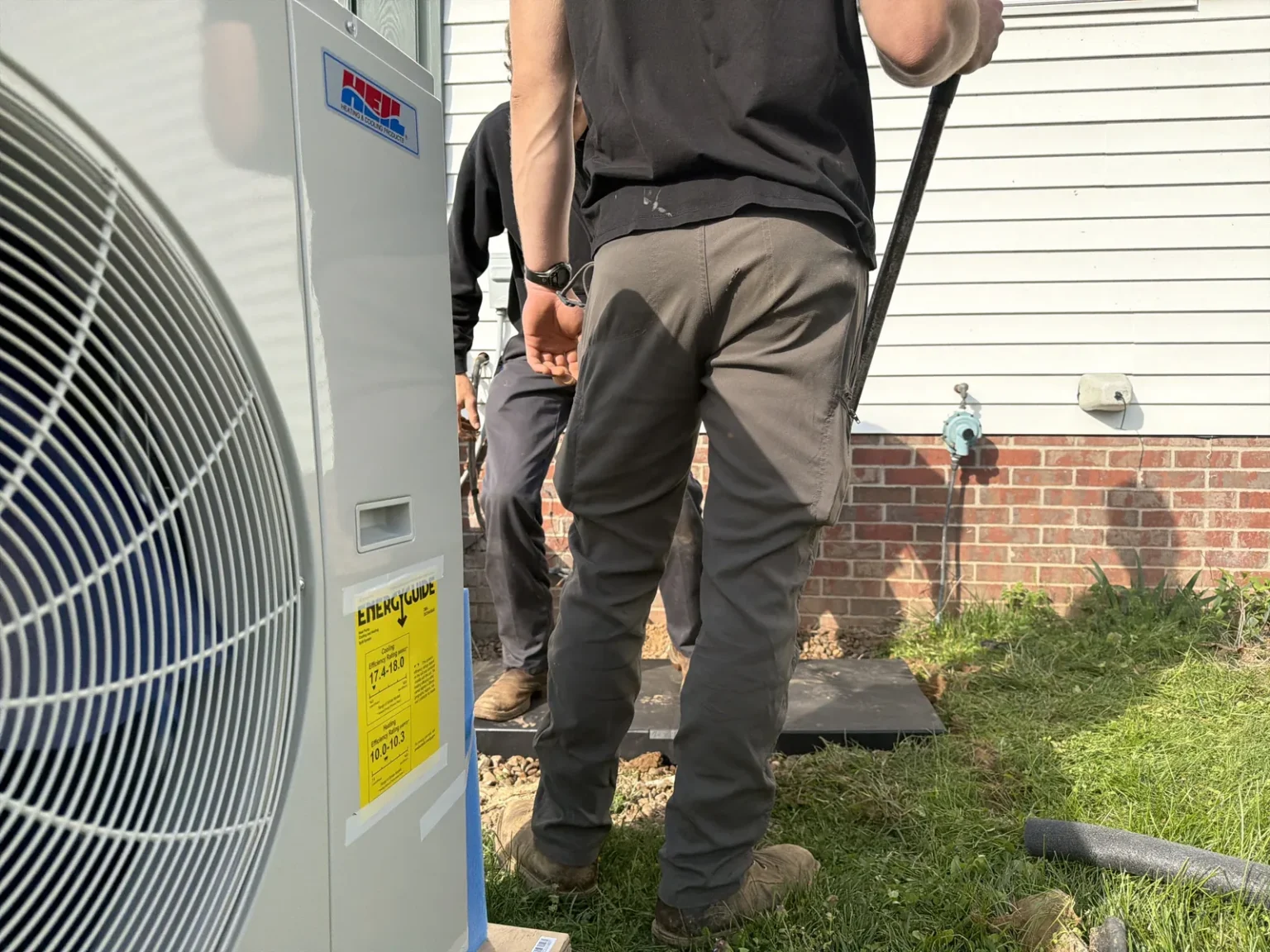
Installation details, airflow, equipment matching, and startup checks all influence how a replacement system performs.
Compare energy use without promising a specific savings number
Newer systems can offer higher efficiency and better comfort features, but actual energy use depends on much more than the rating printed on the equipment. Weather, thermostat settings, duct condition, insulation, air leakage, maintenance, and installation quality all affect the bill. Compare several months or years of utility use when possible, and separate HVAC changes from rate increases or changes in household habits. For a broader homeowner checklist, review ENERGY STAR guidance on when to consider replacing heating and cooling equipment.
When replacement is being considered, ask for the efficiency level, equipment match, control strategy, and any assumptions used to discuss operating cost. Be cautious with guaranteed savings claims. A correctly selected and installed system can improve performance, but the result in a specific home depends on how the entire system operates.
Ask about refrigerant, parts, and equipment compatibility
Refrigerant and component availability can affect the repair decision, particularly when a major leak or compressor failure is involved. The key questions are practical: Is the needed refrigerant and part available? Is the repair technically appropriate? What other original components remain? Does the indoor and outdoor equipment still form a compatible system?
A refrigerant issue should be diagnosed rather than solved by repeatedly adding refrigerant without finding the cause. If replacement of one major component is proposed, confirm that the remaining equipment is designed and approved to work with it. Compatibility, controls, metering devices, electrical requirements, and airflow all matter to reliable operation.
Correct sizing matters more than simply buying a larger unit
An HVAC system should be selected for the home’s heating and cooling load. Oversized equipment may satisfy the thermostat quickly but can cycle frequently, run less efficiently, and provide weaker humidity control. Undersized equipment may run for long periods and struggle during design weather. Square footage alone does not capture windows, insulation, orientation, air leakage, occupancy, additions, or duct conditions.
For replacement, ask how the contractor determined capacity and whether changes to the home were considered. New windows, added insulation, finished space, room additions, or past comfort problems may change the calculation. The existing equipment size is useful information, but it is not proof that the original selection was correct.
Kentucky weather makes humidity and seasonal readiness important
Bowling Green and South/Central Kentucky experience hot, humid summers, changing shoulder seasons, and winter cold that can place very different demands on equipment. Cooling is not only about lowering temperature; runtime and airflow influence moisture removal. Heat pumps also need an appropriate balance of equipment, controls, airflow, and supplemental heat for winter operation.
Think about when breakdowns have occurred and how the system behaves during extended heat or cold. Preventative service cannot eliminate every failure, but it can reveal dirty components, weak electrical parts, drainage problems, airflow restrictions, and other developing issues before the heaviest seasonal use.
What a useful professional evaluation should include
A repair-or-replace recommendation should begin with the current complaint and a system inspection. Depending on the issue, that may include operating temperatures and pressures, electrical readings, airflow observations, filter and coil condition, drainage, thermostat operation, visible duct concerns, and the condition of major components. The technician should also ask about comfort, noise, utility use, repair history, and plans for the home.
If repair is reasonable, the estimate should state the work and explain the expected limitation of that repair. If replacement is recommended, the proposal should identify the equipment, capacity, efficiency, warranty, controls, installation scope, and any duct or electrical work included. Ask how the old equipment will be removed, how the new system will be started and checked, and what maintenance is required.
A practical way to decide
Repair often makes sense when the problem is isolated, the cost is manageable, the equipment has otherwise operated reliably, comfort is acceptable, and parts are available. Replacement becomes more compelling when a major repair is paired with advanced wear, recurring failures, poor comfort, mismatched equipment, difficult parts availability, or a system that is not appropriate for the home.
There is no single age or repair-cost percentage that replaces diagnosis. Compare the repair option, the likely condition after repair, the scope of a replacement, and your tolerance for future downtime. If you are still unsure, ask for both paths in writing. Second Mile provides HVAC repair, installation, replacement, and maintenance across Bowling Green and South/Central Kentucky.
Questions to take into the estimate
• What failed, and how was it confirmed?
• What is the condition of the major components that remain?
• Will the repair address the comfort or performance complaint?
• Are the indoor and outdoor components compatible?
• How was replacement capacity determined?
• What work, controls, warranties, and startup checks are included?
• What maintenance will the repaired or new system need?
Common Questions
Repair-or-replace FAQs
Should I replace my HVAC system just because it is old?
No. Age is one factor alongside the current failure, condition, repair history, comfort, efficiency, parts availability, and system sizing. An inspection should connect the recommendation to evidence from the equipment and the home.
Is a high repair estimate enough reason to replace?
A high-cost repair deserves a replacement comparison, but the decision also depends on what the repair restores, what major components remain, and whether the existing system otherwise performs well.
Will a new HVAC system automatically fix uneven temperatures?
Not always. Uneven comfort can come from equipment sizing, ductwork, airflow, insulation, air leakage, thermostat location, or room loads. Those conditions should be considered before selecting replacement equipment.
What should be included in an HVAC replacement proposal?
Look for the equipment models, capacity, efficiency, controls, warranty, installation scope, startup and testing, removal of old equipment, and any duct, electrical, drain, or accessory work included in the price.
Get a clear HVAC evaluation
Second Mile serves Bowling Green and South/Central Kentucky with HVAC repair, replacement, installation, and maintenance. We will explain what we find and help you compare practical next steps.